King Kong (1933)
“It's money and adventure and fame. It's the thrill of a lifetime and a long sea voyage that starts at six o'clock tomorrow morning.”
– Carl Denham
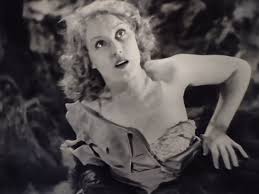
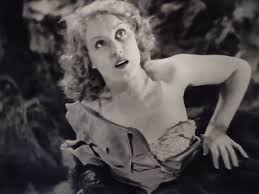
Back to the movie, let’s brush past some of the most clumsily inept lines of flirty dialogue ever muttered in a movie, ever, (Driscoll and Darrow stand guilty) and get to where we’re going, which is the mysterious Skull Island – which is so mysterious, nobody’s ever put it on a map except a Norwegian sea captain, who gave the map to Denham. That’s Denham’s location for his un-named and seemingly unscripted film project. Once there, they meet a hostile tribe of natives who’ve never seen a blonde woman before and want her for sacrifice for their God, Kong. They even offer to buy her, but Miss Darrow is not for sale. Later that night, the tribesmen kidnap her, and the film slams into high gear.
On the opposite side of a huge towering wall that spans the entire width of the island, coast to coast, lives Kong, and tonight, they summon him to receive their tribute, Ann Darrow, tied to two pillars. Even today, 93 years later, Kong’s entrance is stunning, as the giant 24 feet tall gorilla approaches his prize.
Kong was a mixture of a full-sized hand and forearm, a full-sized head (which I’ve never liked because he looks like a leering mentally challenged pervert) and a series of stop motion models in various sizes.
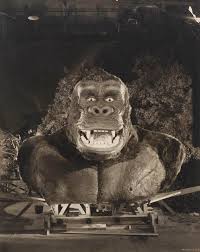
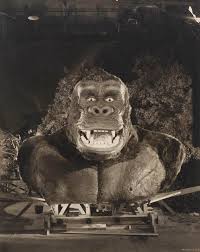
For some, I guess it’s easy to mock the movie making techniques of yesteryear, but apart from the full-sized head, Kong is truly a marvel of his age. The meticulous detailing and smooth motion of his movements are a tribute to the artistry and skill of Willis H. O’Brien and his team of technicians to this day, coming up to a century later.
The chase through the jungle is nothing short of spectacular, as Denham, Driscoll and the ship’s crew pursue Kong. But what nobody told them is that not only does that wall protect the natives from Kong, but also the variety of dinosaurs living there. They’re soon attacked by a Stegosaurus, an aggressive Brontosaurus kills several of the crew as they’re crossing a body of water on a raft, Kong himself sends several of them screaming to the bottom of a canyon as they’re trying to cross on a fallen tree across the top, leaving only Denham to go back to camp to get more help, while Driscoll continues the chase. Kong himself fares little better as far as the attacks are concerned. As he makes his way back to Ann from consigning the hapless sailors into the the canyon, he’s just in time to prevent her from becoming the prey of a Tyrannosaur – and the fight that follows is well up to WWE standard. It’s one of the two highest of the high points of the movie. (The second taking place in the final reel.)
Back in his home on the highest point of the island, he is attacked by a serpent-like Elasmosaurus, and almost loses Ann to a hangry Pteranodon. While Kong is distracted, Driscoll rescues Ann and they make their escape. But Kong follows and destroys the gates through the wall pretty easily, along with the native village, killing several of the tribesmen by stomping them mercilessly to the ground or biting them in half and tossing the bodies away. (These graphic scenes were among several which had previously been cut for TV viewing and never restored until the disc release. They improve the film, highlighting Kong’s bestial nature.)
On the beach, the gas grenades do their work and knock Kong out – he’s now Broadway bound.
Opening night, Kong breaks free, thinking Ann’s in danger and alarmed by the press photographer’s flashes. He goes on a rampage looking for Ann – even climbing the side of a building, reaching in to grab a screaming woman in her high-rise apartment and discarding her to her doom several hundred feet below when he sees she’s not Ann in another previously cut scene.
He eventually finds Ann, but not before a spectacular attack on a subway train.
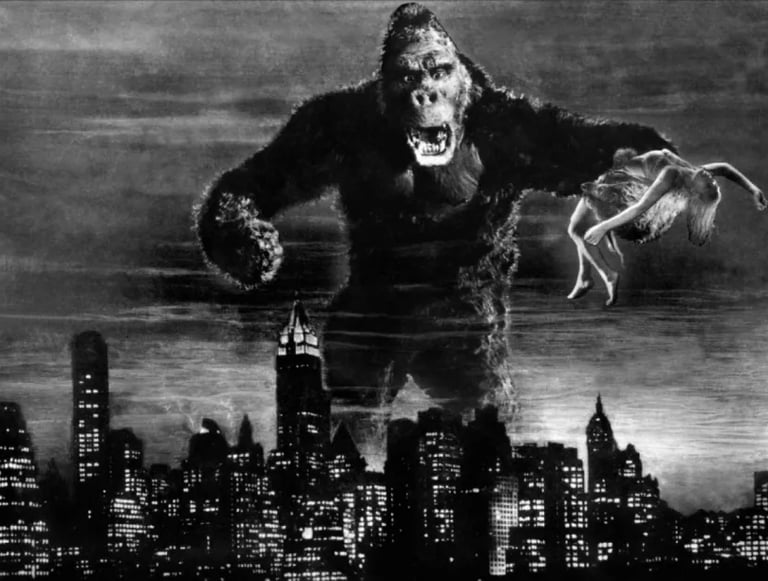
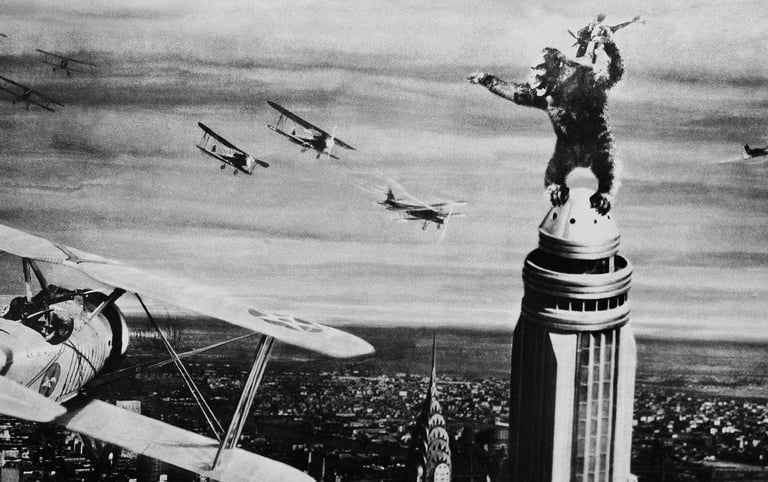
With his precious prize in hand, he heads for the safest place he can see – the highest point. The newly completed Empire State Building, which had opened the year before filming this movie.
I’ve seen a lot of films over the years, and with some luck, I’ll see a lot more before I’m done, but I doubt I’ll see anything that’s much more iconic than Kong’s last stand as he gently places Ann down, and starts to swat away at the biplanes now attacking him. You can’t help but empathise with him as he flails helplessly at the planes strafing him with machine gun fire and Driscoll once again makes the save, guiding Ann to safety before Kong falters and falls to his death, at one point bouncing off the side of the building.
In case anybody’s wondering “why this, why now?” This ties in with an autobiographical personal blog that I published a few weeks ago, where I was reminiscing about my early years, and how I got started with my love for movies, and later on, writing about them. The blog can be found here.
Long story short – it all boils down to this movie. King Kong (1933) the never bettered original, which I saw at the age of eight, and it changed everything. Looking back, I can’t overstate how much this one movie, made 27 years before I was born, has influenced me and what I choose to do with my life. To be honest, Kong gave me an interest, or an obsession that I didn’t choose. It chose me. I just went along with it and enjoyed the ride that my life has become.
A few years ago, I was the head writer for a horror magazine called Gorezone, and one of the cool things that I got to do was interviews with actors, directors and generally horror movie creatives. One of my go-to questions during the interviews was which film got them into horror movies in the first place. It always struck me as uncanny how often THIS particular movie was cited. It has everything. Mystery, adventure, jungles, dinosaurs, special effects, property damage and a sympathetic monster to beat them all. King Kong, the Eighth Wonder of the World.
Were it not for this film, as I’ve said before, you, dear reader, would be reading something else right now. I would never have sought out movies long forgotten by the general mainstream and I wouldn’t have started writing about them to help scratch that fanatical itch that never went away.
So, 1933. Then modern-day America, still gripped by the clutches of the great depression. People are desperate, shelters and soup kitchens are full. In the great city of New York, the tramp steamer Venture is docked, making ready for a hasty departure first thing the next day. Aboard are a film crew. Or, more accurately, Carl Denham (Robert Armstrong) a fast-talking film producer/director/cameraman. Basically, he’s a one-man production company. But his back is against the wall, his agent can’t find him a leading lady and they NEED to be off in the morning, before they’re boarded and inspected. There’s the small matter of a few boxes of experimental gas grenades they’re carrying for the adventure which, if found by the authorities would cause no end of problems. Maybe even arrests.
And what IS the adventure, exactly? Even the ship’s captain, Captain Englehorn (Frank Reicher) and first mate Jack Driscoll (Bruce Cabot) don’t know. Other than they’re heading somewhere to film something. Now Denham has to go ashore and find an actress.
Wandering around the New York streets he comes across the stunning Ann Darrow (Fay Wray) who’s starving and on the cusp of stealing something to eat before fainting. Denham intervenes, buys her a meal and persuades her to come along for the adventure of a lifetime. In reality, Fay Wray was told she’d have the tallest, darkest leading man in Hollywood. They weren’t lying.
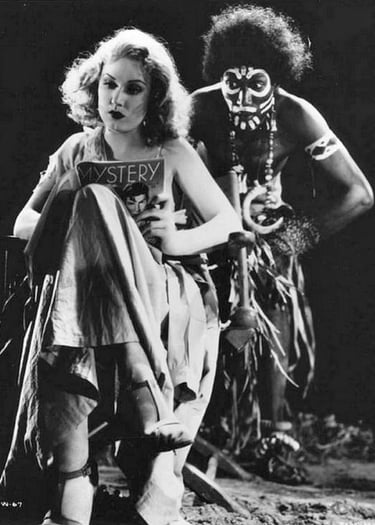
At this point in her career, Fay Wray was THE scream queen of the movies and over 1932-33 she appeared in not only Kong, but also Mystery of the Wax Museum, Doctor X and The Most Dangerous Game. Some of the Most Dangerous Game jungle sets were re-used in Kong.
At street level, Denham corrects a cop who says “the planes got ‘im” by telling him “It was beauty killed the beast”.
As Fay Wray herself said; “Every time I'm in New York, I say a little prayer when passing the Empire State Building. A good friend of mine died up there.”
Well, this is a bit longer than I usually have these retro pieces, but I wanted to pay it a proper tribute due to its role in my life. This is, after all, only the second time I’ve ever written about it. The first time was way back in 1981, after a TV showing of King Kong when I decided in a lightbulb moment to marry up my love of writing with my love of movies and overnight, I discovered my path to reviewing films.
Thank you, Kong,